/The tell-tale signs: identifying the Yellow-legged hornet

The first step in managing an invasion is accurate identification. The Yellow-legged Asian hornet (scientific name, Vespa velutina nigrithorax) has distinct features that set it apart from native European species. Confusion often arises with the European hornet (Vespa crabro) and other large wasps. This guide focuses on the key differentiating characteristics.

The hornet itself: A closer look

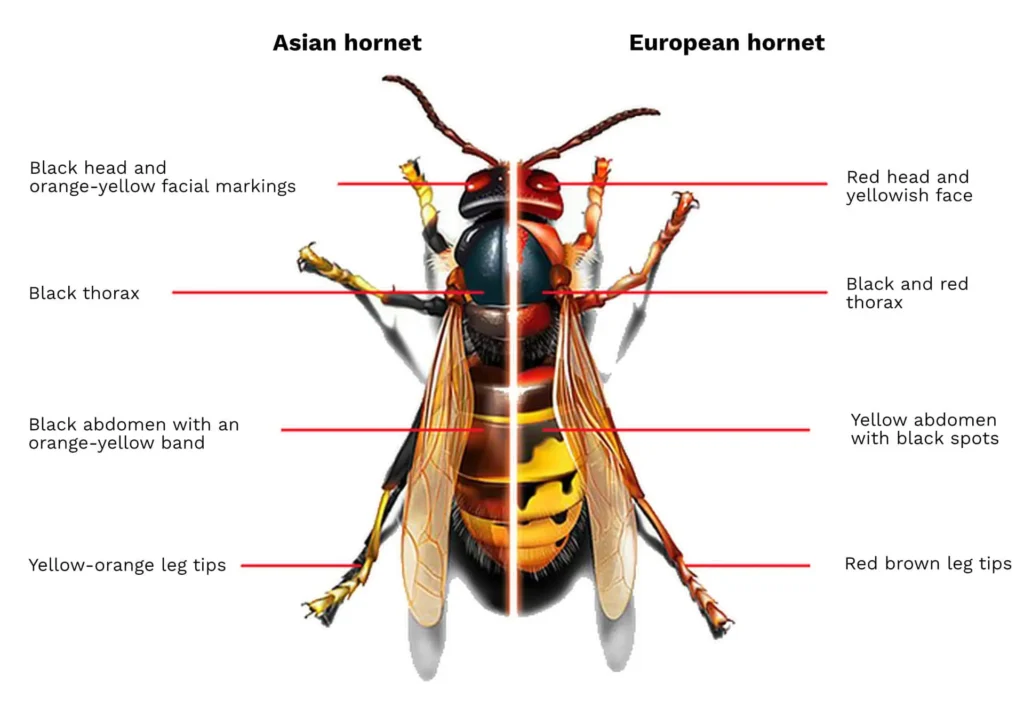
A typical worker Asian hornet is smaller than its European counterpart, measuring between 17 and 25 mm, while queens can reach up to 30 mm (source 1). Do not rely on size alone. The most reliable identifiers are its colouration and behaviour.

  • Abdomen: The abdomen is predominantly dark brown or black. The fourth segment has a narrow yellow-orange band, and the tip is almost entirely yellow.
  • Thorax: The thorax (the middle section) is entirely velvety dark brown or black.
  • Head: The head is black, and the face is orange-yellow with dark eyes.
  • Legs: This is the most distinguishing feature. The legs are brown with characteristically bright yellow ends. This is the origin of the common name “yellow-legged hornet.”

/The nest: finding the source

Primary nest
Secondary nest

Identifying the nest is crucial for control. The hornets build two types of nests throughout their annual lifecycle (source 2).

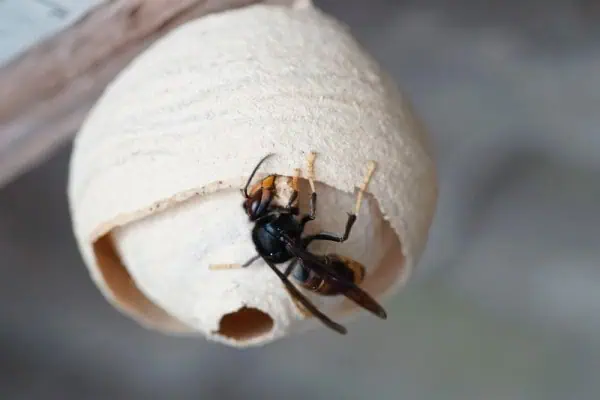
  • Primary nests (Spring): These are often built in sheltered locations like sheds, attics, garages, or dense shrubbery. They are small (about the size of a tennis ball), have a single entrance hole, and are made of a papery material chewed from wood.
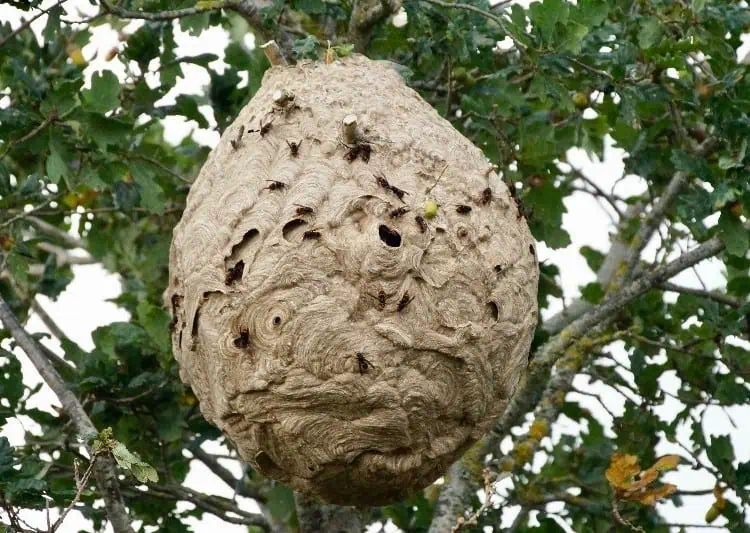
  • Secondary nests (Summer/Autumn): As the colony grows, they often relocate to build a larger, secondary nest. These are typically spherical or pear-shaped, can exceed 60 cm in diameter, and are usually built high in trees, at least 10 metres above the ground. The entrance hole is typically found on the side.
Report a nest

/Behavioural clues

Behaviour can often be the first sign of their presence.

  • Hawking behaviour: The most significant behavioural indicator is their hunting technique at apiaries. They perform a characteristic “hovering” flight in front of beehive entrances, waiting to capture returning honey bees in mid-air (source 3).
  • Flight pattern: Generally, their flight is described as more direct and faster than that of the European hornet.

/What can yellow legged hornets be confused with

Despite its distinctive appearance, Vespa velutina is frequently mistaken for several native European insects. Misidentification is common, especially when individuals are seen in flight or briefly at a food source. The species below are the ones most likely to cause confusion.

Vespula germanica
Vespa Crabo
Volucella zonaria
©Dr Martin Speight
Urocerus gigas
©Q. Rome

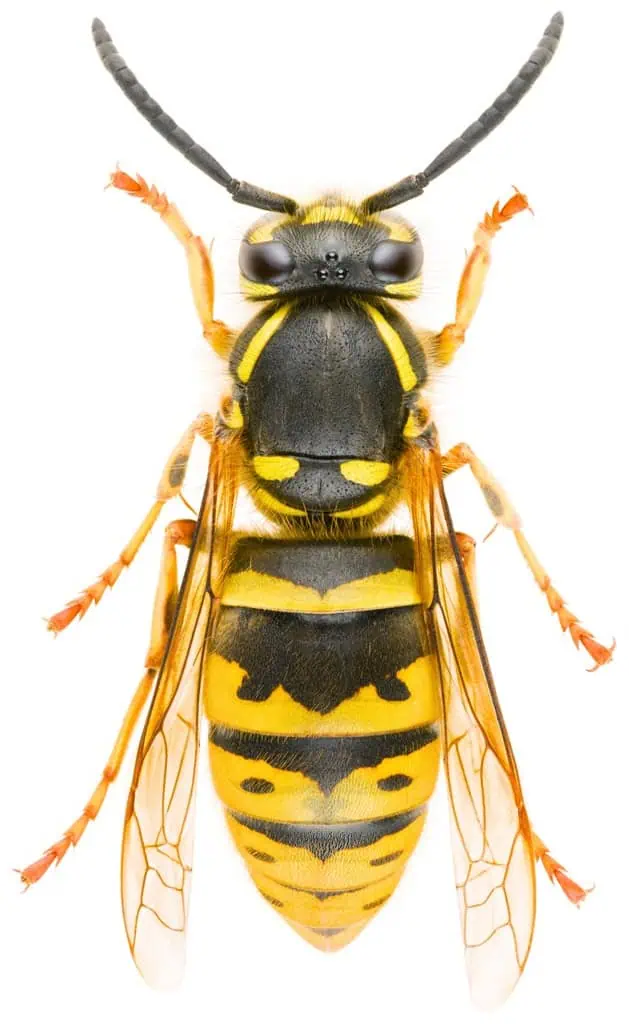
Vespula germanica — European wasp

Common wasps are much smaller and more vividly banded than Vespa velutina, with bright lemon-yellow and crisp black markings. The thorax carries clear yellow stripes, the head is predominantly yellow, and the legs are fully yellow rather than dark with yellow tips. Their flight is quicker and more erratic, and individuals are frequently encountered around food and drink in summer. Although they may appear “dark” in poor light, their size and bright patterning distinguish them from any hornet.

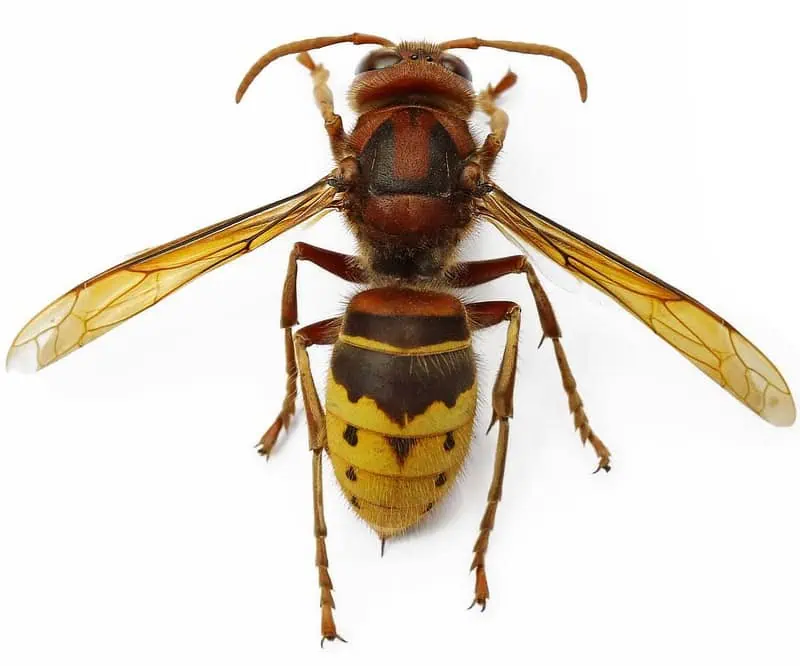
Vespa crabro — European Hornet

Europe’s only native hornet is larger and more robust than Vespa velutina. It shows warm amber tones rather than the stark dark-and-yellow contrast of the Asian hornet. The abdomen is patterned with broad yellow bands interrupted by dark “teardrop” marks. The thorax appears more reddish-brown, and the head is distinctly lighter, often yellowish. The legs lack the sharply contrasting yellow tips that characterise Vespa velutina. Behaviourally, Vespa crabro is less agile in flight and often avoids human activity unless disturbed.

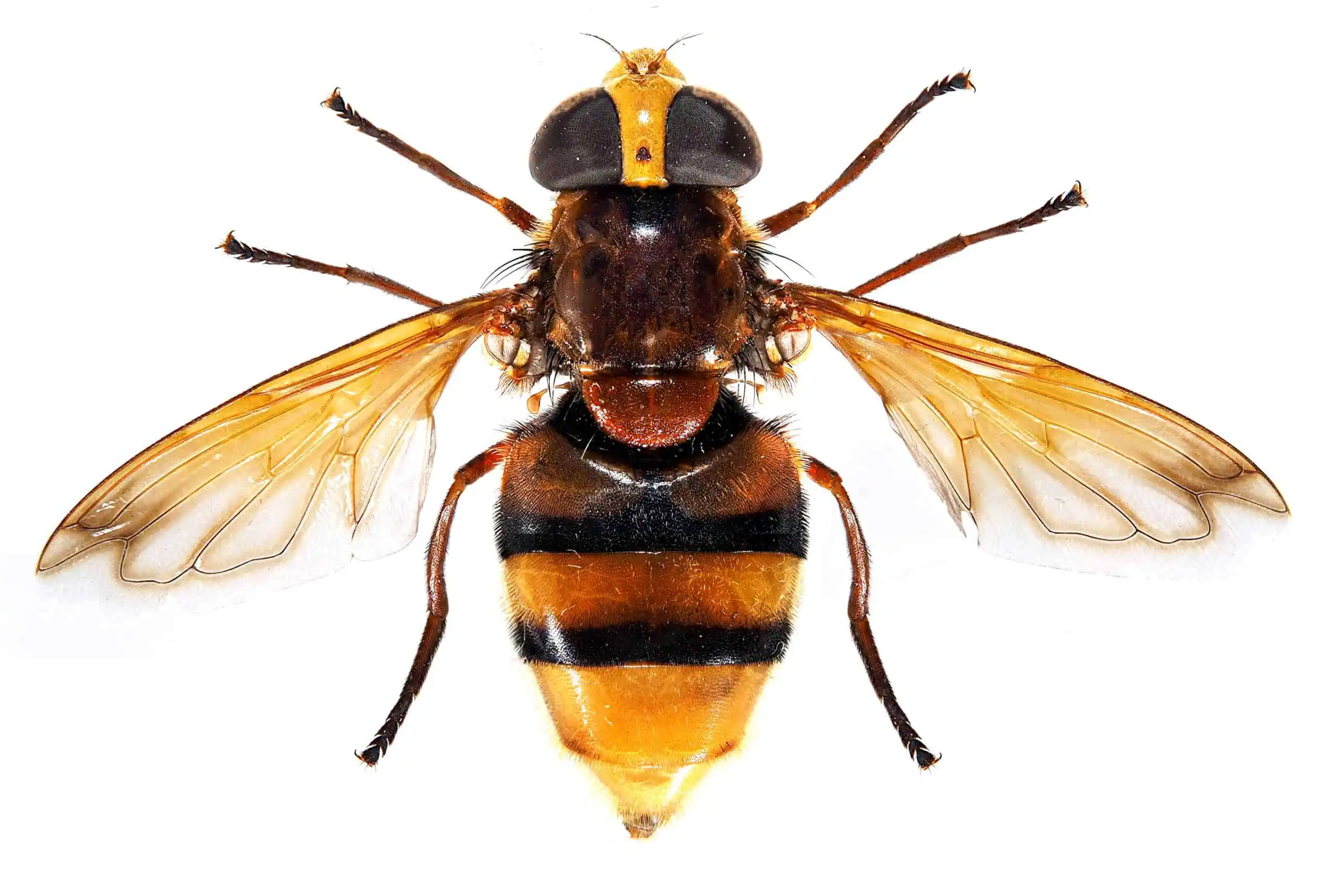
Volucella zonaria — Hornet Hoverfly

This hoverfly mimics the European hornet in colour but lacks the elongated, segmented appearance of true wasps. The abdomen is broad and rounded with clean yellow-and-chestnut bands. The head is dominated by large fly eyes, and the antennae are extremely short. In flight, it produces a soft, low buzz rather than the clear wingbeat of hornets. The legs are fine and pale, never showing the strong brown-to-yellow contrast seen in Vespa velutina. It is harmless and often visits flowers in full sun.

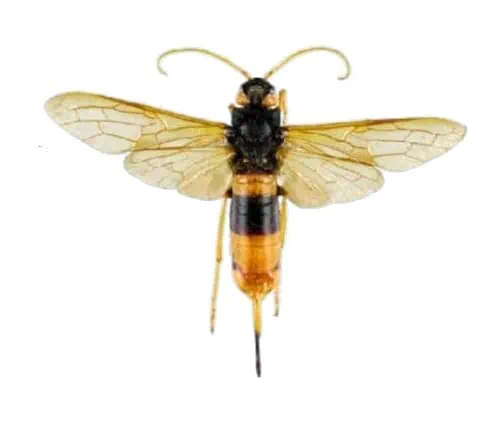
Urocerus gigas — Giant Woodwasp

This species is strikingly large and frequently assumed to be a hornet at a distance. It is, however, a non-stinging wood-boring sawfly. The body is slender with a distinctly wasp-waisted appearance, the abdomen bright yellow with bold black markings. The “sting” is an ovipositor and is held straight to the rear. The head and thorax are yellow-black, and the wings are strongly tinted. Unlike hornets, woodwasps often hold their bodies stiffly in flight and are most often encountered near coniferous wood.