/How to recognize a nest

If the Asian hornet has a secret, it is subtlety. The first nests of the season are small and easy to miss. In spring, a single queen begins her solitary work, choosing a sheltered corner of a shed, attic, or dense shrub, places humans often walk by without noticing. At this early stage, the nest may be no more than a golf‑ball in size: a fragile sphere made of chewed wood fibers, a whisper of a structure that belies its potential (source 1).
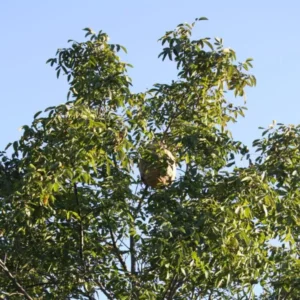
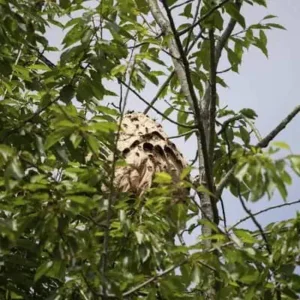
By mid-summer, however, the colony re-locates and scales up. The workers build a much larger secondary nest, frequently in trees, suspending what can become a pear‑ or football-shaped structure high above the ground. These nests can exceed 60 cm in diameter, with an entrance typically on the side (source 2).
Still, size and shape alone don’t tell the full story. Some of the most revealing clues come from hornet behaviour. Researchers have followed their flight paths to pinpoint nest locations: hornets returning from foraging often fly in straight lines, tracing invisible trails through the air to their home (source 3).
That study used radio-telemetry to track individual workers and actually located previously unknown nests up to 1.33 km away — showing how far hornets routinely travel and how cryptic their nests can be (source 4).
Recognizing a nest therefore means more than spotting a papery shape. It’s about reading behaviour, listening for subtle hums, and connecting dots in space. When you’re in doubt, distance is your friend: observe from afar, note directions, and document without disturbing. With careful observation and the right tools, early detection becomes possible. This is the first step toward intervention and control.